
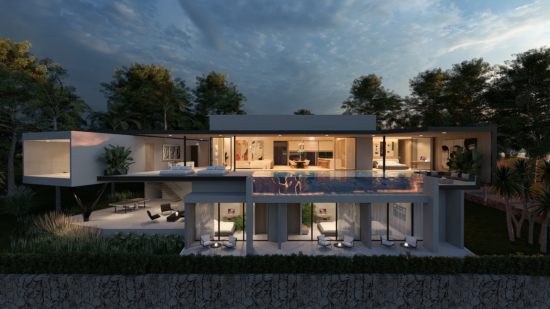
When people talk about a “cohesive home,” they often refer to visual consistency—matching materials, similar colours, or a unified style.
But in my experience, cohesion has very little to do with surface-level decisions.
At Adoani Studio, we approach this differently. As Adoani Architects, we are not trying to create visual uniformity. We are trying to create continuity in how a space is experienced.
Because a home is never understood all at once.
It is experienced gradually—through movement, through transitions, through light, and through changing spatial conditions.
You arrive. You enter. You pause. You move.
And if these moments are not carefully considered, the house may still look refined, but it will not feel complete.
Cohesion, for me, is not about sameness.
It is about everything belonging to the same idea.
It Begins Before the Interior Exists
One of the most common mistakes I see is separating the design process into exterior first, interior later.
This almost always creates a disconnect.
Because once the external form is fixed, the interior becomes something that must adapt rather than evolve naturally.
In our work, we don’t see a boundary between architecture and interiors. The thinking starts as a single system.
Even before entering the house, I consider:
- How the building is approached
- What is revealed and what is held back
- How the first moment of entry is experienced
In many of our projects, especially within Architecture Koh Samui, the arrival is never direct.
Instead, there is always a sense of transition.
You might move through a slightly compressed entry path, a shaded threshold, or a framed view before the main space opens.
This contrast is intentional.
Because without compression, expansion has no meaning.
Designing the Sequence, Not Just the Spaces
Cohesion is built through sequence, not just composition.
When I design a home, I’m not thinking in isolated rooms. I’m thinking about how one space leads into another.
Where does the space open?
Where does it narrow?
Where do you stop?
This creates rhythm.
At Adoani Studio, we often guide movement through subtle spatial adjustments:
- Slight shifts in ceiling height
- Variations in enclosure
- Changes in light intensity
These are not dramatic moves, but they are precise.
They allow the house to feel intuitive.
You don’t question where to go—you simply move through it naturally.
The Threshold Between Outside and Inside
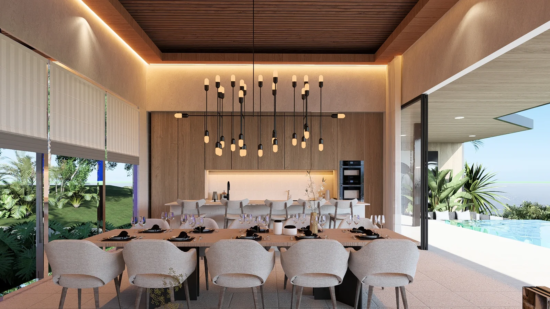
The relationship between exterior and interior is where cohesion is most often lost.
There is a tendency to either separate them too much or open everything without control.
For me, neither approach works.
Instead, I focus on designing the threshold.
The space between outside and inside is not a line—it is a zone.
This is where terraces, semi-open pavilions, and shaded spaces become critical.
Across our projects in Architecture Koh Samui, these transitional spaces are not optional. They are fundamental.
They allow:
- Light to soften
- Temperature to adjust
- Movement to slow down
Without them, the shift from interior to exterior feels abrupt.
With them, the transition becomes seamless.
Continuity Through Materials
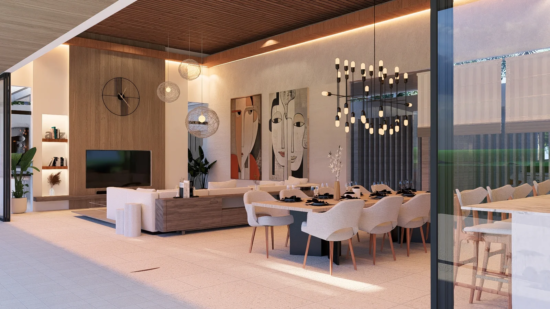
A cohesive home often relies on a controlled material palette—but not repetition.
At Adoani Studio, I prefer to work with a limited number of materials, used with variation rather than duplication.
For example:
- A stone used externally may reappear internally in a more refined finish
- Timber may shift from structural elements to interior surfaces
- Concrete may move from exposed to polished
This creates familiarity without monotony.
It’s also where Adoani Interior Design becomes essential.
Material decisions are not applied later—they are considered from the beginning, ensuring that both exterior and interior feel connected.
A material should not just look consistent.
It should feel consistent in how it ages, reflects light, and interacts with the environment.
Alignment as a Silent Structure
One of the most overlooked aspects of cohesive design is alignment.
It’s not something you immediately notice, but it shapes how the space feels.
In our projects, I pay close attention to:
- How walls align from outside to inside
- How openings relate to structural axes
- How views are framed across multiple spaces
For example, an opening on the façade might align with a corridor, which then aligns with a focal point deeper in the house.
This creates a sense of continuity that goes beyond materials or style.
You feel that the house is structured with intention.
Misalignment, even in small ways, can disrupt that experience.
Light as a Connecting Element
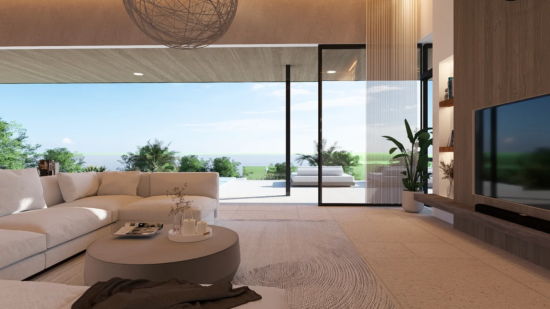
Light is one of the most powerful tools in creating cohesion.
But it’s not about maximising light—it’s about controlling it.
In a cohesive home:
- Light transitions gradually
- Shadows create depth
- Brightness is moderated
At Adoani Studio, I often design openings to shape how light enters and moves through the space.
A narrow opening may create a focused beam.
A wider opening may diffuse light across a surface.
These decisions influence how materials are perceived and how spaces relate to each other.
Within Architecture Koh Samui, this becomes even more critical due to the intensity of natural light.
Without control, light can become overwhelming.
With control, it becomes a unifying element.
Detailing That Carries Across Boundaries
Cohesion is often defined in the smallest details.
At Adoani Studio, a significant amount of time is spent resolving:
- Material junctions
- Edge conditions
- Transitions between surfaces
For example:
- How a floor continues from inside to outside
- How a ceiling extends into a covered terrace
- How frames are detailed consistently
These details ensure that the house does not feel assembled in parts.
This is also where Adoani Interior Design plays a crucial role—ensuring that interior elements follow the same logic as the architecture.
Even small inconsistencies can break continuity.
Interiors as an Extension of Architecture
A common issue in residential design is treating interiors as something separate.
Furniture is selected later. Finishes are added independently.
This often creates a disconnect.
In our work, interiors are considered from the beginning.
At Adoani Studio, and within our approach to Adoani Interior Design, we look at:
- Built-in elements that are part of the architecture
- Furniture layouts that align with spatial proportions
- Materials that extend across both conditions
This ensures that interiors do not feel placed within the space—they feel like they belong to it.
Avoiding Disconnection
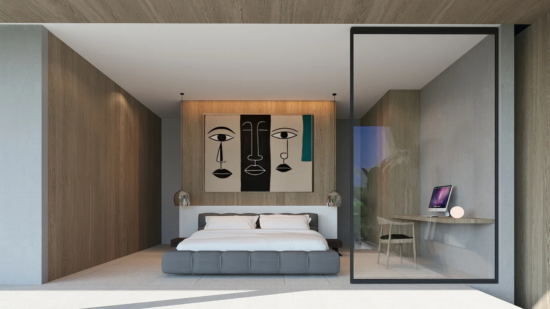
Through experience, I’ve seen several patterns that disrupt cohesion.
One of the most common is designing each space independently.
Individually, they may work well. But together, they lack connection.
Another issue is overuse of materials.
Too much variation creates visual noise and weakens the overall identity of the home.
Abrupt transitions are also problematic:
- Sudden changes in light
- Sharp material contrasts without relationship
- Immediate exposure to exterior conditions
Cohesion requires restraint.
Not everything needs to stand out.
Some elements need to support quietly.
Designing for How the Home Is Lived
Cohesion is not only visual—it is experiential.
A home should feel consistent in how it supports daily life.
This means:
- Movement should feel natural
- Spaces should relate functionally
- Transitions should adapt to different times of day
At Adoani Studio, I always consider how the house will be lived in.
Where do people gather?
Where do they retreat?
How do they move between these conditions?
These patterns influence how the architecture connects.
Our Approach at Adoani Studio
For us, creating a cohesive home is not about applying a style.
It is about maintaining clarity across every decision.
We focus on:
- Designing the exterior and interior as one system
- Creating controlled transitions
- Using materials with intention
- Resolving details with precision
- Allowing light and environment to shape the space
This is the approach that defines our work as Adoani Architects, particularly within the context of Architecture Koh Samui.
Each project is different, but the objective remains consistent:
To create a space that feels unified—not because everything looks the same, but because everything works together.
Final Thoughts
A cohesive home together to create a complete experience.
And when that happens, the house no longer feels like a collection of spaces.
It feels like one.
is not something you immediately notice.
It’s something you feel as you move through space.
There is a sense of continuity.
A sense of calm.
A sense that everything is resolved.
At Adoani Studio, this is what we aim to achieve.
Because in the end, architecture is not about individual elements.
It is about how those elements come.
Read More at https://lookwhatmomfound.info/