
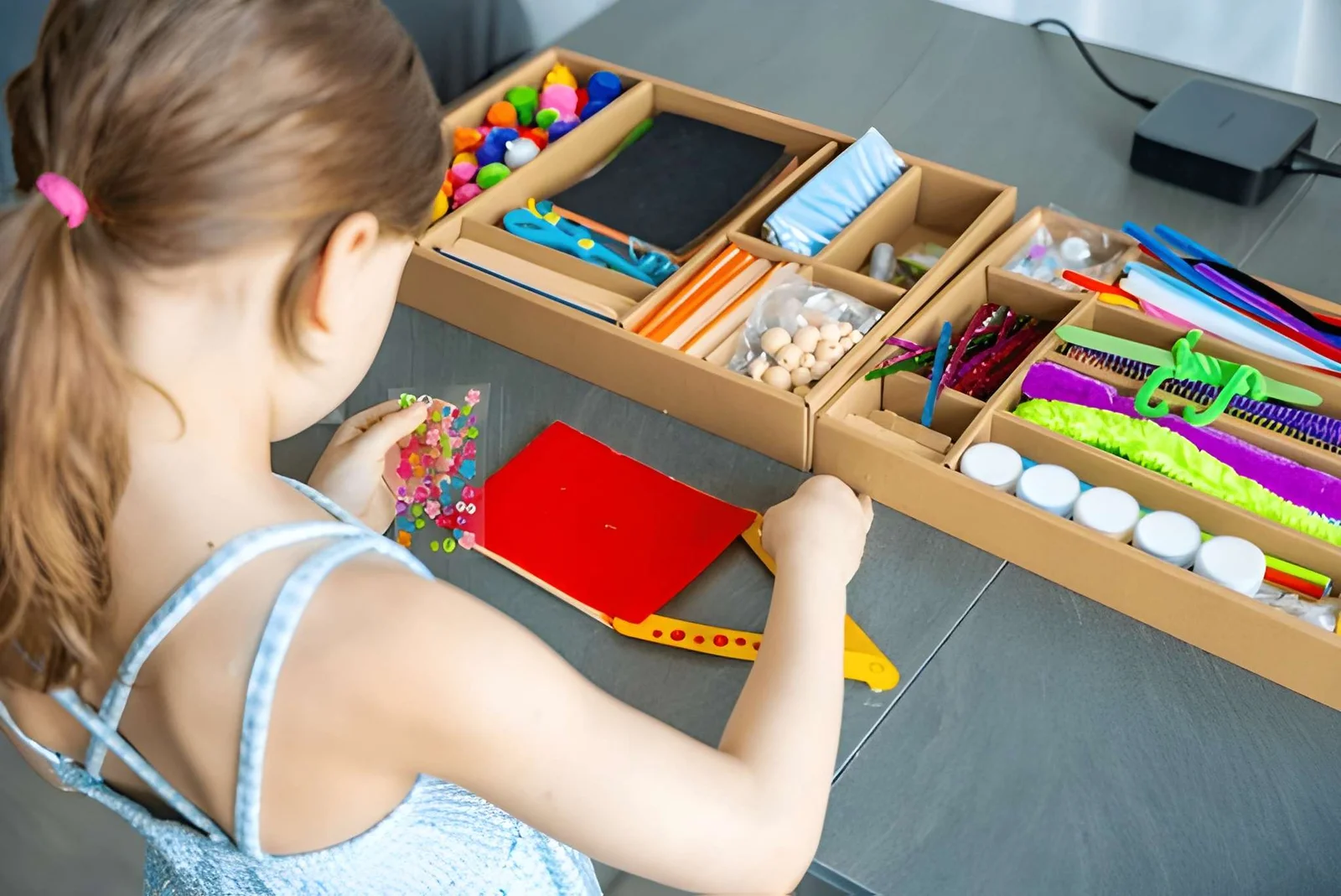
A craft kit can be the best rainy-day gift or the fastest route to a half-finished project in the bottom of a closet. The difference is rarely the price. It is whether the kit asks a child to follow instructions or to make decisions. If you are wondering which craft kits encourage kids’ creativity, the clearest pattern is this: the kits with more choices and fewer rules tend to spark more imagination.
I have watched a child finish a bead-bracelet kit in twenty minutes and never touch it again, then spend a whole week with a tub of pipe cleaners, craft sticks, and glue. The first kit had a right answer. The tub did not.
That does not make guided kits bad. They teach specific skills, and some children love knowing exactly what to do. The goal is to pick the right kind for the child and the moment.
This article is general information, not educational or medical advice. It covers a quick answer, a comparison of kit types, a guide by age, safety labels, a buying checklist, mistakes to avoid, and a short FAQ.
Which craft kits encourage kids’ creativity?
The craft kits that best encourage creativity are open-ended: assorted materials such as paper, paint, clay, craft sticks, pipe cleaners, and washable markers, with no single required outcome. Hybrid kits with a few ideas and plenty of freedom also work. Highly guided kits are better for learning techniques than for free expression.
How do kit types compare?
| Kit type | Creativity level | Best for | Watch for |
|---|---|---|---|
| Open-ended supply tub | Highest | Pipe cleaners, craft sticks, pom-poms, and washable markers encourage deeper creative thinking | Needs adult setup for younger kids |
| Process art kit (paint, clay, collage) | High | Material exploration and self-expression with unique results | Mess |
| Hybrid kit | Medium to high | Includes steps and design suggestions, plus open-ended supplies | Check that it allows changes |
| Guided skill kit | Medium | Highly guided kits are excellent for teaching specific techniques | May discourage experimenting |
| Template or paint-by-number | Low | Calm focus time | Finished work looks identical |
What does research say?
| Finding | Source |
|---|---|
| Process art | Early childhood standards highly recommend process art over restrictive product art |
| Confidence | Open-ended play lets children experiment without fear of not making it correctly, building creative confidence |
| Adult role | Adults act as facilitators with rich materials and non-judgmental feedback |
| What to say | Comment on effort and process instead of labeling the finished work |
| Art access | Access to art supplies has been linked with improved cognitive skills and well-being |
These are guidance and association, not proof that any single kit works.
Which kit suits which age?
| Age | What to look for |
|---|---|
| 3 to 5 | Large-format, pre-cut, or peel-and-stick materials and washable adhesives |
| 3 to 5, also | Minimal steps and a high tolerance for errors |
| 6 to 9 | Child-safe scissors, origami, simple weaving, and beginner stamping |
| 6 to 9, also | Visual diagrams help them follow along independently |
| Pre-teens | More mature, higher-quality materials |
For younger children, look for kits that finish in fifteen to thirty minutes.
What safety labels matter?
| Label | Meaning |
|---|---|
| ASTM D-4236 | A federally mandated label showing chronic health hazards are properly labeled |
| ACMI AP seal | Indicates an approved product |
| “Non-toxic” | Federal law does not define it, so check the ASTM statement |
| Under-3 warning | The 0 to 3 choking hazard symbol flags small parts such as beads and googly eyes |
| Warning or Danger signal word | Avoid these for children |
What mistakes should you avoid?
- Buying by picture. Check what the child actually does with the kit.
- Correcting the result. Praise effort, not neatness.
- Choosing too hard. Frustration ends crafting fast.
- Ignoring labels. Check age and conformity statements.
Frequently asked questions
Are guided craft kits bad for creativity?
No. They teach skills. Pair them with open-ended supplies afterward.
What is the best craft kit for a 4-year-old?
Large, washable, easy-to-handle materials with few steps.
Can you make your own craft kit?
Yes. Fill a box with paper, glue, safe scissors, and recycled items.
Bottom line
Pick open-ended or hybrid kits for creativity, guided kits for skills, and always check age and safety labels. Praise the process, not the product, and keep the supplies where your child can reach them.
for more information visit https://lookwhatmomfound.info/